OUR APPROACH

A field-tested framework to scale your business

Built on 30 years of operating experience, the ASCALATE approach looks at your company through two lenses: where growth is constrained, across five Scale Engines, and which capabilities are required to scale, along the four steps of the Scaling Journey.

Take the Scale Scorecard → Let's scale
OUR PRINCIPLES

Four principles behind every engagement

01

Business first, technology second

We start from where the business needs to scale, never from where a tool could be used.

02

Diagnose before prescribing

Every recommendation rests on a structured diagnosis of all five Scale Engines, not on a favorite theory.

03

Fix the process before automating it

AI multiplies what exists. We make sure it multiplies a good process.

04

Value is captured, not assumed

Time saved only becomes value when roles, decisions and performance management change with it.

HOW IT WORKS

Two lenses, one diagnosis

Scaling fails when companies fix the wrong thing first. Our approach answers two questions before recommending anything.

LENS 1 · THE FIVE SCALE ENGINES

Where is the business constrained?

They show where growth, margin or execution is being held back.

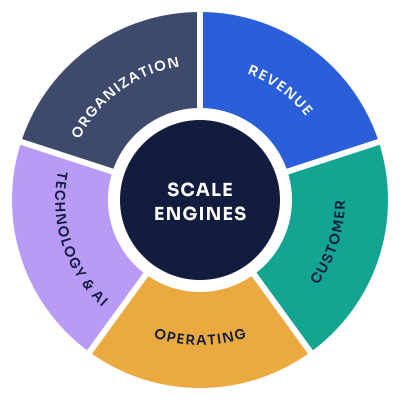
The five Scale Engines: Revenue, Customer, Operating, Technology and AI, Organization
LENS 2 · THE SCALING JOURNEY

Which capabilities are missing to scale?

It shows what the company needs to build to remove those constraints.

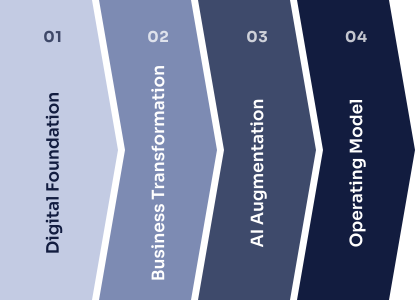
The Scaling Journey in four steps: 1 Digital Foundation, 2 Business Transformation, 3 AI Augmentation, 4 Operating Model

Crossed together, the two lenses form the ASCALATE Scale Map: a precise picture of what to build, engine by engine, and where improvement will create the most value.

LENS 1: THE FIVE SCALE ENGINES

The five Scale Engines: where growth is constrained

Every lever that scales a company sits in one of five engines. Each engine maps directly to revenue, operations or profit.

Revenue Engine

How effectively can the company generate, convert and scale revenue?

WHAT WE ASSESS
Growth OpportunitiesBrand Awareness & AuthorityValue PropositionGTM ModelMarketing–Sales AlignmentROI-Driven MarketingPricingSales PracticesSales Performance
WARNING SIGNS
  • Inconsistent pipeline and poor predictability
  • Weak win rates
  • Growth concentrated in a few customers
  • Inconsistent pricing and excessive discounting
BUSINESS IMPACT

More inbound leads from a stronger brand, a more predictable pipeline, higher win rates, shorter sales cycles, a sharper pricing strategy, management by performance.

→ Scale your revenue

Customer Engine

How effectively can it retain, expand and create value from its customer base?

WHAT WE ASSESS
SegmentationCustomer ExperienceSuccess ModelRetention & ChurnAccount DevelopmentCross-Sell & UpsellCustomer Lifetime Value
WARNING SIGNS
  • Churn discovered too late, and its cost unknown
  • Little or no cross-sell and upsell
  • No clear view of customer profitability
  • High dependence on personal relationships with key customers
BUSINESS IMPACT

Lower churn, secured recurring revenue, cross-sell and upsell lift, a higher new-logo rate, deeper solution adoption by each customer.

→ Scale your revenue

Operating Engine

How efficiently can it execute, automate and increase throughput?

WHAT WE ASSESS
Cost StructureProcess EffectivenessProductivity & CapacityDelivery PerformanceStandardizationMake-or-Buy & SourcingShared ServicesNearshore & Offshore
WARNING SIGNS
  • Costs grow as fast as revenue
  • Growth that requires almost proportional headcount growth
  • Margins vary materially across customers, products or projects
  • Heroic efforts that compensate for weak processes
BUSINESS IMPACT

Leaner cost base, delivery margin uplift, higher throughput, simplified and standardized operations ready to scale.

→ Scale your operations

Technology & AI Engine

Do applications, data and AI provide the capabilities required to scale?

WHAT WE ASSESS
Business ApplicationsData QualityMonitoring & AnalyticsAI AssistantsAI-Embedded ApplicationsAI Agents & Digital TeamsSystems Scalability
WARNING SIGNS
  • Performance known weeks after it happens
  • No reliable single source of truth
  • A proliferation of AI pilots with limited adoption or measurable impact
  • Systems unable to scale with growth, acquisitions or new geographies
BUSINESS IMPACT

Structured data, real-time performance visibility, AI Business Agents deployed at scale and adopted by the teams.

→ Scale your operations

Organization Engine

Do structure, talent, accountability, cadence and governance support the next level of performance?

WHAT WE ASSESS
GovernanceOperating CadencePerformance CultureHuman TalentLeadership EffectivenessCompany ValuesDigital Capacity
WARNING SIGNS
  • Decisions escalate to the CEO and senior leaders
  • Numerous and constantly changing priorities
  • Underperformance tolerated for too long
  • Key people overloaded
BUSINESS IMPACT

A cadence that turns decisions into fast action, individual and collective accountability, operational excellence, capacity without proportional headcount.

→ Scale your profit

The diagnosis rarely finds one problem. It finds the two or three constraints that hold back everything else.

LENS 2: THE ASCALATE SCALING JOURNEY

Four capabilities. One path to scalable performance.

Companies do not need another technology roadmap. They need to know which capabilities are required to scale, and how technology, best practices, AI and the operating model work together to create lasting value.

1

Digital Foundation

Business applications and data that run the company.

Unlocks: structured data, performance made visible
SIGN IT IS MISSING

Fragmented business applications, performance known weeks late, data rebuilt in spreadsheets, no single source of truth: every team defends its own numbers.

WHAT WE DO

Rationalize core systems, set up master data and its governance, define the data that drives decisions, build live dashboards.

2

Business Transformation

Processes, workflows and governance redesigned around proven best practices.

Unlocks: operational excellence
SIGN IT IS MISSING

No alignment on best practices: the same task done five different ways, heroic efforts instead of repeatable processes, complexity piling up with every exception.

WHAT WE DO

Simplify and standardize critical processes around best practices, designed as if the company were twice as big; set clear decision rights and performance rituals.

3

AI Augmentation

AI that augments employees and multiplies execution capacity.

Unlocks: scale and acceleration
SIGN IT IS MISSING

Isolated AI pilots multiply, AI maturity stays low, adoption is limited and the impact is never measured.

WHAT WE DO

Deploy the AI Executive Brain for augmented decision-making and AI Business Agents for automated execution, on the processes that matter.

4

Operating Model

How people, AI agents, processes and governance work together.

Unlocks: operating leverage and EBITDA
SIGN IT IS MISSING

Headcount grows with revenue and productivity gains are absorbed. AI agents run task by task, without validation or control rules.

WHAT WE DO

Recompose roles, decision rights and hybrid human–AI governance; design AI agents within end-to-end processes, with clear validation and control rules, so productivity becomes profit.

Each capability unlocks the next, turning AI productivity into sustainable business value.

A COMMON QUESTION

Do the four capabilities have to be built in sequence?

No. But maturity compounds.

You do not need to complete one capability before starting the next. AI can create value today, even while data, processes or the operating model are still evolving.

The real distinction is between using AI and scaling value from AI.

Weak data foundations limit how reliable AI can be.
Poor processes limit what should be automated.
An unchanged operating model limits how much productivity becomes economic value.

As maturity rises across the four capabilities, so does the company's ability to scale and capture value. Each capability strengthens the next.

THE SCALE MAP

Where should you act first?

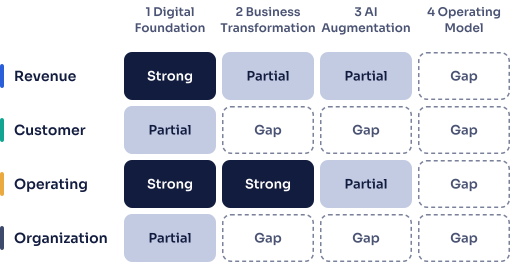
There is no single maturity level for a whole company: each Scale Engine has its own. The Scale Map crosses the engines with the four capabilities of the scaling journey to show what to build first, engine by engine, so priorities come from evidence, not intuition. Technology & AI is not a separate row: it runs across every engine and evolves at each step of the journey, through the Digital Foundation and AI Augmentation columns.

Take the Scale Scorecard
ILLUSTRATIVE EXAMPLE
Strong Partial Gap
Illustrative Scale Map. Revenue: Strong, Partial, Partial, Gap. Customer: Partial, Gap, Gap, Gap. Operating: Strong, Strong, Partial, Gap. Organization: Partial, Gap, Gap, Gap, across Digital Foundation, Business Transformation, AI Augmentation and Operating Model.
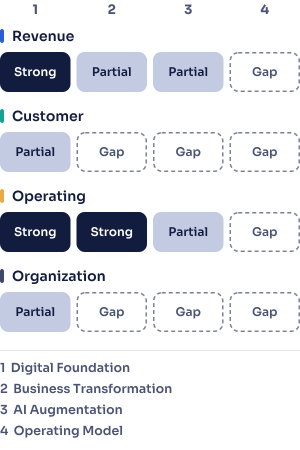
Illustrative Scale Map, mobile layout: Revenue Strong, Partial, Partial, Gap; Customer Partial, Gap, Gap, Gap; Operating Strong, Strong, Partial, Gap; Organization Partial, Gap, Gap, Gap.

This company has solid systems and efficient operations. Yet its Customer and Organization engines lack the processes and governance to scale. Deploying AI in sales now would accelerate a fragile model; fixing retention processes and decision rights first will unlock far more value.

IN PRACTICE

From diagnosis to measurable results, in five steps

1

Explore 360°

We scan every lever across the five Scale Engines: no blind spots, no pet theories.

Scale Diagnostic
2

Prioritize

We rank opportunities by impact, speed and feasibility into a pragmatic, execution-ready scaling roadmap.

Scale Diagnostic
3

Execute

A senior operator works alongside your team until the metrics move.

Scale Execution Office
4

Industrialize

We embed AI into processes, operations and reporting.

Scale AI Office
5

Sustain

An operating cadence and a live dashboard keep performance on track, and capability is transferred to your team.

Scale AI Office
See our solutions
FAQ

Frequently asked questions

What is a business scaling framework?

A structured way to identify the capabilities a company needs to grow without increasing cost and complexity at the same rate. The ASCALATE approach combines five Scale Engines, which show where growth is constrained, with the four capabilities of the Scaling Journey, which show what must be built to remove those constraints.

What are the five Scale Engines?

Revenue, Customer, Operating, Technology & AI, and Organization. Together they cover every lever that drives revenue, operations and profit, so the diagnosis leaves no blind spot.

What are the four capabilities of the ASCALATE Scaling Journey?

Digital Foundation, Business Transformation, AI Augmentation and Operating Model. They connect structured data, best practices, AI-enabled capacity and organizational design to turn technology and productivity into sustainable business performance.

How do you assess a company's maturity?

We rate each Scale Engine on five maturity levels, from Reactive to Scalable, using leadership interviews, operational data and a structured assessment. We then cross the engines with the four capabilities in a Scale Map, which shows where to act first and where improvement will create the most value.

Which Scale Engine should a company fix first?

Start with any engine at risk, at level 1 or 2. Then lay the foundations, governance and data, before accelerating. Within that order, the moves with the most business impact come first, so they fund and de-risk the next ones.

Why should business transformation come before scaling AI?

AI makes existing activities faster, but speed does not improve the underlying process. Reviewing processes, workflows and governance first ensures that AI increases the capacity of an effective process rather than amplifying unnecessary complexity.

Does a company need full digital maturity before using AI?

No. AI can be deployed at any level of maturity. But scaling it reliably depends on the quality of the underlying data, processes and governance.

How does an operating model turn AI productivity into business value?

The operating model defines how people, AI, processes, decision rights and performance management work together. When AI creates capacity, it determines whether that capacity becomes more output, faster decisions, lower cost and revenue growth, or is simply absorbed by the existing organization.

LET'S SCALE

Where does your company stand?

Take the Scale Scorecard: 28 questions, about 8 minutes, and a first view of the maturity of your five Scale Engines.

Take the Scale Scorecard → Let's scale